
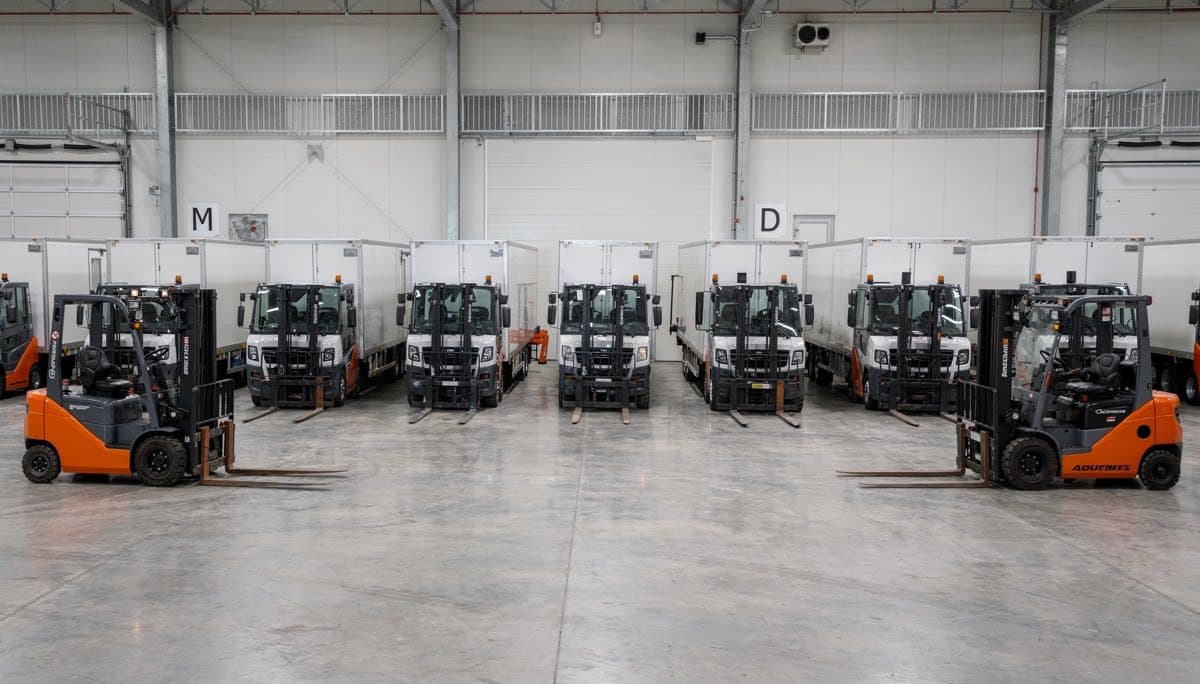
Many transport companies have a large share of their capital in the vehicles they already operate. Tractor-trailers, trucks and boxes work every day, but that money is not available to the rest of the business. A sale and leaseback, also written «sale & leaseback» or «lease back», is designed for exactly that. This article explains it with a practical example.
What a sale and leaseback is
It is a two-part deal agreed at the same time:
- You sell vehicles you already own to a lessor.
- You keep using them under a lease, for a monthly payment.
The vehicles don't leave your operation. They stay on your routes, with your staff. What changes is who owns them and how you pay to use them. The capital that was tied up in them goes back to your company.
Illustrative example, step by step
Illustrative example. The figures are hypothetical round numbers to explain how it works. They are not market prices or an offer.
A transport company owns 10 tractor-trailers. All of them are paid off and working. It has just won a new contract and needs liquidity to start it: more staff, fuel, tolls and working capital while it collects its first invoices.
Step 1. Choose which vehicles go in. The company decides to include 4 of its 10 tractor-trailers. It doesn't have to put in the whole fleet. It chooses the vehicles that make sense for the operation.
Step 2. The vehicles and the company are reviewed. The lessor analyzes the vehicles (model, condition, documentation) and the company's profile. At PIXXO, the answer comes within 48 business hours once we have the essential documentation to review the case.
Step 3. The value and the rent are agreed. Suppose, just for the example, that a value of $1,000,000 per vehicle is agreed. For the 4 vehicles, the company would receive $4,000,000, according to the terms set in the contract. At the same time, the monthly rent and the lease term are agreed.
Step 4. The deal is signed and the payment received. The sale and the lease are formalized. The company receives the money from the sale.
Step 5. The operation carries on. The next day, the 4 tractor-trailers are still going out on their routes, with the same drivers. The difference is that the company now pays a monthly rent to use them and has liquidity for the new contract.
Before and after in the example
| Before | After | |
|---|---|---|
| Vehicles in operation | 10 tractor-trailers | 10 tractor-trailers |
| Vehicles owned | 10 | 6 |
| Vehicles under lease | 0 | 4 |
| Liquidity from those 4 vehicles | Tied up in the vehicles | Available to the business ($4,000,000 in the example) |
| Monthly payment for those 4 vehicles | None | Agreed monthly rent |
The working fleet is the same. What changes is where the capital is.
A real case
The example is hypothetical, but the structure is not. HM SA de CV, a perishables distributor with a refrigerated fleet, turned 4 productive assets into liquidity through sale & leaseback and kept operating the same vehicles.
What the liquidity is used for
It is each company's decision. Some common uses:
- Working capital to cover the start of a contract or a busy season.
- Renewing other vehicles in the fleet.
- Growing: opening a route, adding clients or investing in the operation.
What matters is that the monthly rent stays in line with the income the operation generates. Before deciding, it is best to run the numbers with your finance team.
When it makes sense and when it doesn't
It may make sense if:
- You own vehicles in good condition and will keep needing them.
- You need liquidity without stopping the operation.
- You'd rather not have all your capital tied up in the fleet.
It may not make sense if:
- You plan to sell those vehicles soon or stop using them.
- The monthly rent doesn't fit comfortably in your cash flow.
The accounting and tax effects of selling an asset and then leasing it depend on the contract, the asset and your tax regime. Validate them with your accountant before deciding.
Sale and leaseback vs operating lease
Both are leases. The difference is the starting point:
- Operating lease: the vehicle isn't yours yet. The lessor acquires it and you pay to use it during the term.
- Sale and leaseback: the vehicle is already yours. You sell it to the lessor and keep using it.
To learn more about operating leases, read the guide to leasing productive assets or the article on operating lease vs financial lease.
What PIXXO offers
At PIXXO we work with operating leases and sale & leaseback. If you already own tractor-trailers, cargo trucks, dry vans or buses and vans, a specialist reviews with you whether sale & leaseback applies to your vehicles. See how it works on the sale & leaseback page.
Before you start, check the requirements: a legal entity incorporated in Mexico, with at least 12 months of operation and minimum annual revenue of $3M MXN.
PIXXO offers operating leases and sale & leaseback. It does not offer credit.